



You’re halfway through a brutal morning commute, somehow victorious after snagging an actual seat. You sink in, pop your headphones on, and let your favorite podcast drown out the chaos. Then comes the chime. That hollow little ding that every wireless listener dreads. The audio fades, the world rushes back in, and you still have fourteen stops to go,
Or maybe your battlefield is your desk. Third coffee in, you reach across your workspace when the sable catches your chair arm again, and your laptop lurches toward the edge like it’s auditioning for a disaster movie.
Welcome to one of the most quietly passionate debates in modern audio: Wired vs. Wireless.
It sounds trivial until it isn’t. Because this choice isn’t really about a product. It’s about how you move through your day, whether you prize the purity of an uncompressed signal or the freedom to pace your kitchen during a call that absolutely could have been an email.
This guide cuts through the noise. Whatever kind of listener you are, I will help you find the headphones that actually fit your life.
Key Takeaways
- Wired headphones offer better sound quality with zero compression and minimal latency.
- Wireless headphones provide greater convenience and freedom to move.
- Latency is lower in wired models, making them ideal for gaming and editing.
- Wireless audio quality has improved with modern codecs like aptX and LDAC.
- Wired headphones last longer, while wireless models depend on battery life.
- The best choice depends on your lifestyle and how you use your headphones.
Quick Comparison: Wired vs Wireless Headphones at a Glance
If you are in a hurry, this summary table provides a high-speed breakdown of how these two technologies compare across the most important categories based on technical specifications and user experience.
| Feature | Wired Headphones | Wireless Headphones |
| Sound Quality | Best: lossless, uncompressed audio data. | Great and improving: relies on codecs (LDAC, aptX). |
| Latency | Near-zero: typically 5 to 10ms. | Variable: 40ms to 300ms (Bluetooth/RF). |
| Convenience/Mobility | Limited: tethered to the device by a physical cord. | High: freedom to move, dance, or pace freely. |
| Battery Life | No battery required: powered by the source device. | Battery dependent: requires regular recharging. |
| Durability | High: fewer internal electronic parts to fail. | Moderate: internal batteries eventually degrade. |
| Gaming Performance | Excellent: zero lag for competitive play. | Good: models like Yealink HA64 Pro use 2.4GHz. |
| Price Range | More affordable performance-per-dollar. | Generally higher due to internal DACs and batteries. |
The Core Mechanics: Wired vs Wireless Headphones
To understand which type is right for your ears, we must first look under the hood at the engineering that makes your music possible. If you’re curious about the science behind audio drivers and sound reproduction, explore how do headphones work for a deeper breakdown. The fundamental difference lies in the signal path and how audio data moves from your device to the drivers in the ear cups.

Wired Mechanics
Wired headphones are honest about what they are. No hidden intricacy, no trickery. Just sound, sent via a wire from your gadget to your ears.
Your device’s built-in DAC (Digital to Analog Converter) converts the digital file into an electrical signal when you press play. The signal passes through a tiny part known as a driver, down the cable, and into the earcup. Your brain interprets the small waves created by the driver’s vibration of a paper-thin membrane as music.
It’s beautiful because there isn’t much between you and the sound. There’s no compression or battery deterioration in your pocket. Just a straight line from the source to the ear.
Wireless Mechanics
Wireless headphones travel to the same location in a more picturesque manner.
When you hit play, your device uses Bluetooth to broadcast the audio over the air after compressing it into a digital stream, a wireless standard maintained by the Bluetooth Special Interest Group that enables short-range audio transmission between devices.
That signal is picked up by your headphones, which then pass it through the drivers, an onboard DAC, and an integrated amplifier. All of this takes place in the earcups you hardly notice, silently, and in milliseconds.
Even more features are frequently included in modern wireless headphones, such as touch controls, integrated microphones, and real-time active noise cancellation. If you want to understand the technology behind it, explore how noise cancelling headphones work for a deeper explanation.
The tradeoff is real. Wireless headphones tend to be heavier and pricier. But what they offer in return is something a cable never can: the freedom to simply get up and walk away, completely untethered, with your music still playing.
The Audiophile’s Dilemma: Sound Quality Comparison
Wired headphones have a straightforward advantage here. Every minute detail the artist intended is preserved as the audio signal travels straight from your device to your ears, unaltered and uncompressed.
The headphone design also plays a big role in how that sound reaches you, which is why many listeners compare Open back vs Closed Back Headphones when choosing a setup for critical listening.
However, modern Bluetooth codecs like Sony LDAC and aptX HD have significantly reduced the difference. The majority of individuals truly can’t discern the difference while listening on a daily basis. Wired still prevails in critical listening.
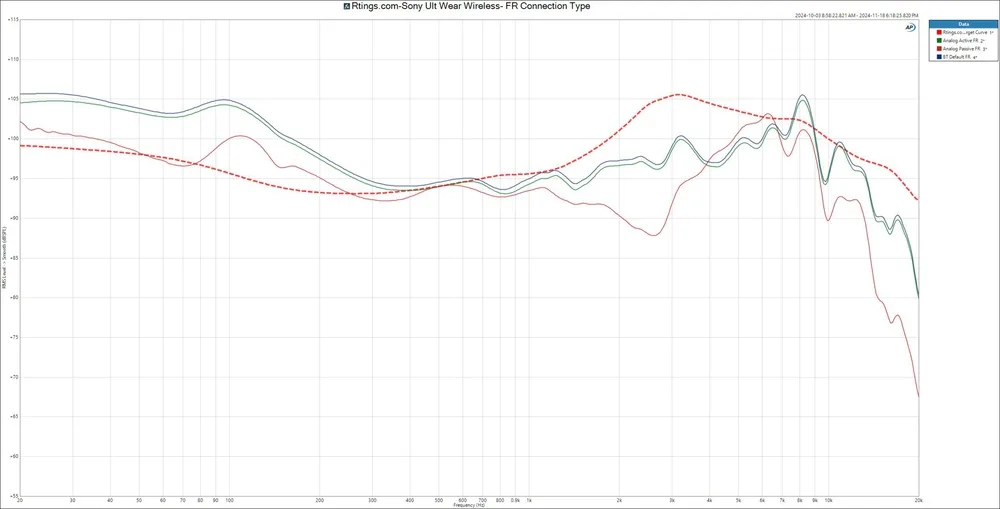
This frequency response graph shows how similar the Sony ULT WEAR headphones sound when used via their wired and wireless connections, provided the headphones are switched on. When used via their cable and switched off, they produce less bass and treble.
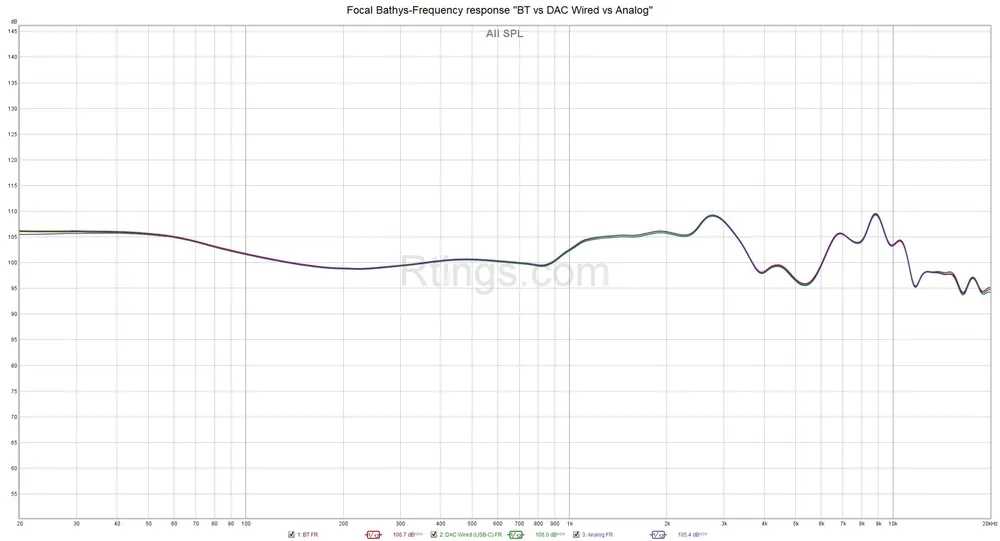
The Focal Bathys Wireless also sound the same whether used wirelessly via Bluetooth or wired via their DAC mode.
Speed Matters: Latency and Performance
Latency is the tiny delay between a sound happening and you actually hearing it. Casual listeners rarely notice it. Gamers, editors, and streamers absolutely do.
Wired headphones:
- Latency of just 5 to 10 milliseconds, practically invisible to the human ear
- Perfect audio and video sync every time
- Zero interference from surrounding devices
Wireless headphones:
- Standard Bluetooth introduces 100 to 300 milliseconds of delay
- Audio has to be compressed, transmitted, and decoded before it reaches you
- Dedicated 2.4 GHz gaming headsets can cut that down to around 20 milliseconds
Wireless has improved, but wired remains the cleaner, more precise option.
Living Untethered: Convenience and Mobility
In this case, wireless headphones are unquestionably superior. You and your audio are free to move throughout the day without any connections or limitations.
- Use multi-device pairing to connect to your laptop and phone at the same time.
- Without missing a beat, switch between a call and a playlist.
- Move around without dragging, yanking, or snagging anything.
Wireless headphones are a better fit for people who constantly multitask, commute, and work out.

Source: Portronics Muffs M3
Power Struggles: Battery Life and Charging
Not every headphone manages power in the same manner. Some rely solely on the device they are attached to, while others have built-in batteries that power the music. Although this distinction may not seem like much at first, it can affect how practical your headphones are for long listening sessions, daily use, and travel.
Wired headphones:
- Borrow power directly from your device
- No charging, no battery anxiety, always ready to go
- Perfect for long travel days and marathon listening sessions
Wireless headphones:
- Compact earbuds last roughly 5 to 6 hours per charge
- Larger over-ear models can comfortably cover a full day
- Batteries degrade gradually over time with repeated charging
- Some models include a passive wired mode for when the battery gives out
Built to Last: Durability and Longevity
Most individuals anticipate using headphones for years rather than just a few months. The way they are built plays a big role in how long they last. While some designs emphasize durability and simplicity, others depend on sophisticated electronics that can eventually need more maintenance.
Wired headphones:
- Simple design means fewer components that can fail
- No battery means no internal decay over time
- Premium models with detachable cables are easy and cheap to repair
Wireless headphones:
- Packed with batteries, chips, and processors, all of which age over time
- Battery capacity fades after hundreds of charge cycles
- Compact true wireless earbuds are notoriously difficult to repair once the battery dies
Wireless headphones escape the cable problem, but carry a quiet expiration date that wired headphones simply do not have.
The Health Question: Are Wireless Headphones Safe?
It makes perfect sense to question what all that unseen energy is doing close to your ears when wireless signals are flying about everywhere.According to the World Health Organization, the comforting response is that wireless headphones are deemed safe for daily usage.
The radio frequency energy they produce is extremely low, well within internationally established safety limits, and no strong scientific evidence currently links them to health risks during typical use like music, calls, or podcasts.

Additionally, there are several risks associated with wired headphones. A simple cord can produce its own kind of turmoil, as anybody who has pulled a laptop off a desk in mid-step or almost face-planted due to a cable hooked on a chair leg will attest.
In all honesty, both formats are safe when used appropriately. Keep an eye on your surrounds, control your cords, and pay attention to your volume. The kind of connection behind your ears is not as important as those habits.
Buying Advice: How to Choose the Right Headphones
Before you click buy, go through this practical checklist to ensure you are getting the right tool for your specific needs:
- Identify Your Primary Use Case: Will these be for the gym, for long gaming sessions at home, or for a noisy office commute?
- Check Your Budget: Remember that wired headphones offer better sound quality at lower prices, while wireless models charge a premium for convenience and internal tech.
- Verify Compatibility: Does your phone have a 3.5mm jack? If not, are you prepared to carry a USB-C adapter? If going wireless, does your device support high-quality codecs like LDAC or aptX?
- Consider Comfort: For long listening sessions, look for pressure-relieving headbands and soft ear cups (found in models like the Soundcore Space One Pro).
- Look for Passive Mode: If you choose wireless, try to find a model that includes an audio cable so you can still listen if the battery dies unexpectedly.
Conclusion
There is no wrong answer here, only the wrong headphones for the wrong person.
If you are someone who sinks into an armchair with a glass of something good and wants to hear music exactly as it was recorded, every breath, every string, every quiet detail the artist hid in the mix, then a wired pair is your best companion. Plug in, press play, and disappear.
If you are someone who cannot sit still, who listens while cooking, commuting, pacing, and living, then wireless headphones are not just a convenience. They are a genuinely better fit for the life you actually lead.
The best headphones are not the ones with the most impressive spec sheet. They are the ones you forget you are wearing because they just work, every single day, without getting in your way.
And honestly, for the listeners who refuse to choose? Keeping one of each around is not indecisive. It is wisdom.
FAQs
1) Wired vs wireless headphones: which is better?
It depends on what you value most. Wired headphones are better for sound quality and reliability, while wireless headphones offer more freedom and convenience.
2) Are wired headphones better?
Wired headphones often deliver clearer sound and zero latency because the audio signal travels directly through the cable without compression.
3) Are wired headphones better than wireless?
In many cases, yes. Wired models often provide better audio quality for the price since the budget is focused on sound rather than batteries or Bluetooth technology.
4) Are wireless headphones safe?
Yes. Wireless headphones emit very low levels of radio frequency energy that fall within global safety limits and are considered safe for everyday use.