



You’ve done the research, read the rave reviews, and finally invested in a pair of high-end, 600-ohm over-ear headphones. You plug them into your smartphone, expecting a symphonic explosion, but instead, you get a “quiet whisper.” Is the hardware broken? Probably not. You’ve likely just run into a classic case of impedance mismatch.
To understand why this happens, we have to look at Nominal Headphone Impedance, the rated electrical resistance of your headphones, measured in Ohms (Ω). It determines how much a headphone resists the electrical current sent from your audio source.
Think of impedance as the “traffic rules” for the electricity in your gear. Just like cars on a road, the smoother the electrical flow (or traffic), the better your music sounds. If the rules are too restrictive for the “car” (the source device) to handle, the journey and your audio quality suffer.
If you’re just using your phone, don’t overcomplicate this; matching your gear is simpler than it sounds once you understand the numbers.
Key Takeaways
- Headphone impedance (Ω) determines how much power your device needs to properly drive your headphones.
- Low impedance headphones (16-32Ω) are ideal for smartphones and laptops because they require less voltage.
- High impedance headphones (80-600Ω) offer better driver control but typically need a dedicated amplifier.
- When comparing high impedance vs low impedance, the right choice depends on your audio source and not the highest Ohm rating.
- Headphone impedance vs sensitivity both affect volume: impedance controls power demand, and sensitivity controls loudness efficiency.
- Match your headphones to your setup, or even premium gear can sound underpowered.
What Is Headphone Impedance?
Most people never question what happens between pressing play and hearing sound. Inside every headphone, a tiny diaphragm connected to a copper coil vibrates against a magnet, and those vibrations become your music.
The way this system works depends heavily on the different kinds of drivers used in headphone design, from traditional dynamic drivers to more advanced planar magnetic and electrostatic setups. Manufacturers use thinner wire to make that coil lighter and more precise, but thinner wire resists electrical current more. That resistance is impedance.
In electrical engineering, impedance is defined as the total opposition a circuit presents to alternating current, combining both resistance and reactance, a standard concept documented by the Institute of Electrical and Electronics Engineers (IEEE).
Low impedance headphones are easy to use and run happily off a phone or laptop. High impedance headphones are pickier and need a proper power source before they reveal what they are truly capable of.
Get the match right, and your music sounds exactly as it was meant to. Get it wrong, and even the most expensive headphones in the room will quietly underperform.
Typical Headphone Impedance Levels (16Ω to 600Ω)
Impedance levels vary widely depending on the intended use of the headphones:
- 16–32Ω: These are designed for high efficiency. They are the perfect match for smartphones, tablets, and laptops, which have limited power output.
- 32–80Ω: This is the “sweet spot.” These are versatile enough for audio interfaces, creator setups, and most modern PCs. An example is the DT 770 PRO (80Ω), which balances professional performance with mobile accessibility.
- 80–250Ω: This is studio-grade territory. These headphones often require dedicated amplification or a robust audio interface to perform at their best.
- 250–600Ω: This is high-end audiophile territory. Without a powerful amplifier, headphones like the DT 990 Edition (600Ω) will suffer from the “whisper effect,” sounding thin and quiet because the source can’t overcome the resistance.
Although headphones are labeled with a nominal impedance value such as 32Ω or 300Ω, their actual impedance is not constant and varies across different frequencies. The graph below illustrates how impedance typically changes across the audible frequency range.
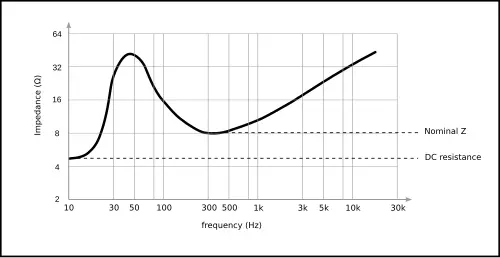
Source: Educational Illustration of Impedance Response Behavior
Headphone Impedance vs Sensitivity: What Affects Volume More?
While impedance is about resistance, Headphone Sensitivity measured at 1kHz in dB SPL/mW or dB SPL/V is about efficiency. It is the direct indicator of how loud a headphone will get with a specific amount of power.
Impedance tells you how much work the amp has to do, and sensitivity tells you how much sound output you get from that work. Headphones with sensitivity above 110 dB/V are considered “high sensitivity” and can reach high volumes even from low-voltage (under 1 Volt) smartphone outputs.
Because sensitivity directly affects maximum loudness, high-sensitivity headphones can reach unsafe listening levels even when powered by low-voltage devices like smartphones.
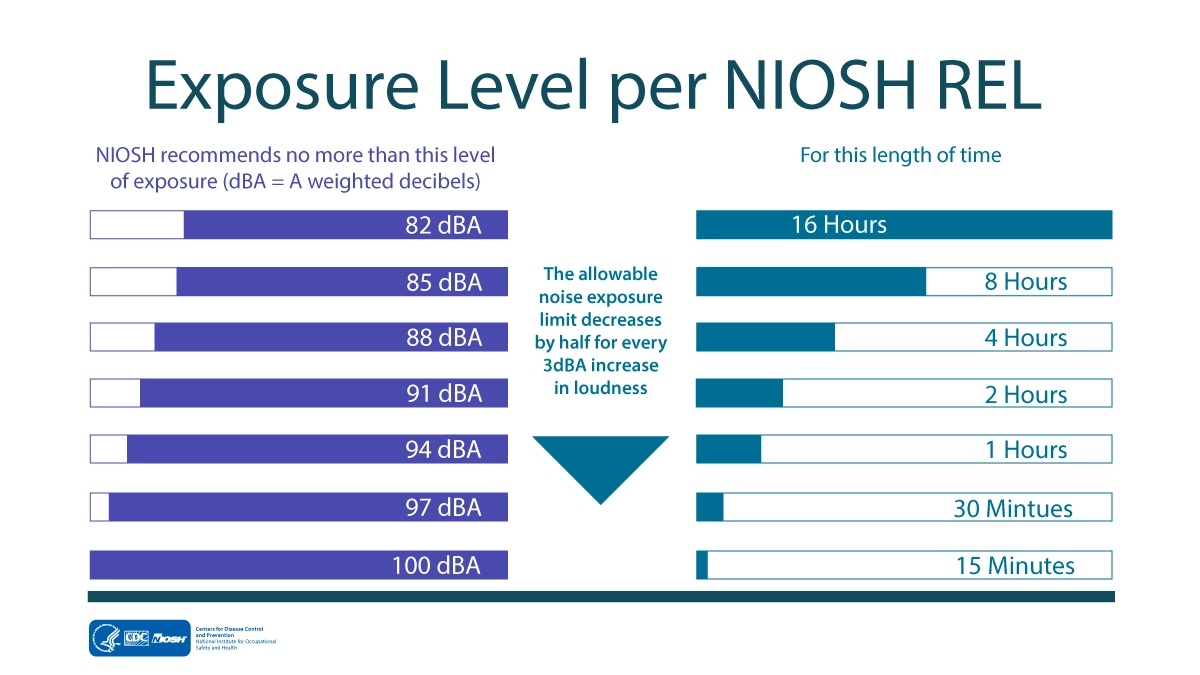
As decibel levels increase, safe listening time drops dramatically. For example, exposure at 100 dBA is recommended for only 15 minutes per day, reinforcing why headphone sensitivity plays a critical role in real-world listening safety.
What Is Headphone Impedance Matching? (The 1:10 Rule Explained)
To get the best sound, you have to consider the relationship between “load impedance” (your headphones) and “source impedance” (your device output).
The primary Rule of Thumb for audio engineers is the 1:10 rule. This principle aligns with general circuit design guidance discussed in foundational electronics literature such as The Art of Electronics by Paul Horowitz and Winfield Hill, which explains voltage transfer efficiency in load-source relationships.
The load impedance of your headphones should be at least 10 times higher than the source impedance of your amplifier. While a 1:8 ratio is often cited as the bare minimum, the 1:10 ratio ensures optimal “voltage matching.” If the source impedance is too high relative to the headphones, it can result in unwanted coloration of the sound, poor damping, or a reduction in frequency bandwidth.
Is Higher Impedance Better or Worse?
There is no “better” only “better for the situation.”
Traditionally, High Impedance offered superior resolution because the thinner, lighter voice coils could be controlled more accurately. However, modern engineering is changing the game.
For example, the Stellar.45 driver utilizes high flux density and a specialized coil configuration to achieve professional-grade precision and high sound pressure levels even at lower impedance ratings.
- High Impedance still offers the best protection against distortion at high volumes in studio environments.
- Low Impedance offers mobile convenience and high efficiency for on-the-go listening.
Here’s where buyers get tripped up: more Ohms doesn’t always mean more “quality” if your amp can’t drive them. A 600-ohm headphone powered by a phone will sound significantly worse than a 32-ohm headphone on that same phone.
How to Measure or Check Headphone Impedance
If you are unsure of your equipment’s specs, you can check impedance in three ways:
- Manufacturer Data Sheets: Always the most accurate source for “Nominal Impedance.”
- Multimeter: You can use a standard multimeter to measure the DC Resistance (DCR) of the voice coils. The National Institute of Standards and Technology (NIST) defines DC resistance measurement as a reliable method for determining baseline electrical resistance, though impedance varies with frequency under AC conditions.
- Online Calculators: Use impedance and SPL calculators to determine the necessary V/dBu output required to drive your headphones to a safe, clear volume.
The Right Pair Was Always Out There
Great audio has never really been about the price tag. It has always been about understanding what your setup is actually asking for.
Phone listeners who want music that moves with them belong in the 16–32Ω world. Gamers living inside their favorite universes will feel right at home between 32–80Ω. The studio perfectionist who agonizes over every frequency finds their truth in 80–250Ω. And the audiophile who treats listening as a ritual, not just a habit, finally meets their match at 250–600Ω with a dedicated DAC/Amp beside them.
Nobody warns you that buying the wrong headphones for your setup is like pouring a fine wine into a paper cup. The wine is still great.
You just never actually tasted it. So before you chase specs and brand names, learn how to properly choose headphones based on your device, listening style, and power source. Because somewhere in that impedance range is a sound that was built for exactly how you heard, and once you find it, you will wonder how you ever settled for anything less.
FAQs
1) What’s the ideal impedance for headphones?
It depends on your device. For a phone, 16–32Ω is ideal. For a studio with a dedicated amp, 250Ω or higher is the professional standard.
2) Do I need an amplifier for high impedance headphones?
Yes. For anything 250Ω or above, an amplifier is generally required to reach optimal sound quality and prevent the “whisper effect.”
3) Can I use low-impedance earbuds with a professional DJ mixer?
You can, but it’s risky. Professional mixers have high output voltage; if you turn the volume up, you run a high risk of “blowing out” the low-resistance coils in consumer earbuds.
4) Does higher impedance always mean better sound?
Not necessarily. While high impedance allows for lighter coils, modern drivers like the Stellar.45 prove that you can achieve high fidelity at lower impedances through superior magnetics and driver design.